By communications coordinator Kayleigh Lane
A Quantum Physicist and a climate scientist walked into a bar…
And what they came up with might help save the world.
If you’re like me and are interested in environmental protection, but find the physical sciences incomprehensible, you might also be surprised to learn about the fruitful intersection of these two disciplines.
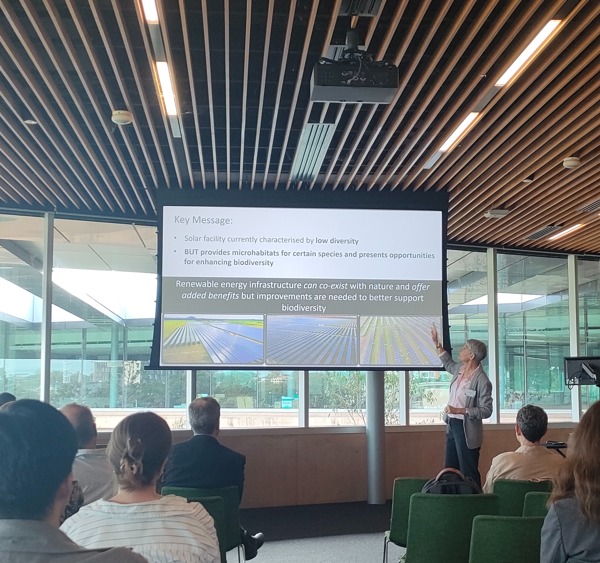
The Quantum Meets Decarbonisation forum was recently held in Brisbane, with the objective of gathering leading researchers in the fields of quantum physics and decarbonisation to explore how one of today’s most complex technologies can help address one of this generation’s greatest challenges: the climate impacts of anthropogenic emissions.
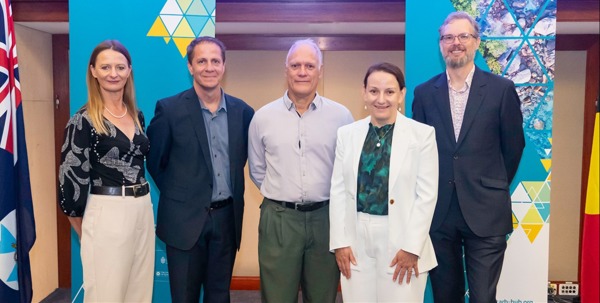
I attended the forum with my colleagues at the Qld Decarbonisation Hub to learn how innovations in quantum technology could help accelerate Australia’s journey to net zero.
Professor Belinda Wade, one of the Hub’s researcher’s, facilitated a keynote on the gaps and corporate response to decarbonisation technologies, which highlighted the ways that climate change both directly and indirectly impacts businesses, and the future direction of climate-related disclosures and adaption.
We were lucky enough to hear from Australia’s former Chief Scientist, Dr Cathy Foley, and Queensland’s Chief Scientist, Professor Kerrie Wilson, who both outlined the nation-wide opportunities in quantum innovation, but also the barriers that could hinder their roll out. I was surprised to learn of Australia’s rapidly evolving quantum industry, with more than 50 quantum startups supported by strong federal and state investment in a push to reinforce Australia’s place as a leading nation in quantum innovation.
Brisbane, more specifically, is in the global race to host the world’s first utility-scale quantum computer. Dr Geoff Pryde, Chief Technical Director of PsiQuantum Australia, shared progress of the quantum computing facility under construction near Brisbane Airport. Once operational, it will be one of the most advanced facilities of its kind in the world, positioning Queensland at the forefront of this new industry. Quantum computing’s advantage is being able to solve certain complex problems in a fraction of the time it would take a classical computer, and in a crisis where time is running out, speed is a major advantage.
The pharmaceutical giant Boehringer Ingelheim (BI) is an early example of the benefits we may be able to expect once quantum computing reaches prevalence. BI researchers collaborated with PsiQuantum to calculate the electronic structure of a key metabolic enzyme (cytochrome P450) in just four minutes, which would take 10100 years with a classical computer!
That same computational power could be harnessed to model complex systems in energy, agriculture and material science, which could dramatically improve our ability to decrease emissions across sectors and value-chains.
Some of the possible applications of quantum technology (from quantum sensing to quantum computing) in decarbonisation initiatives include:
- Improved emissions tracking (including monitoring fugitive emissions, stored carbon and methane emissions from agriculture and waste)
- Improved monitoring of nitrogen runoff in coral reefs
- Accurate detection of critical mineral deposits
- Improved photovoltaic efficiency and battery design
- Optimised chemical reactions to reduce emissions and increase efficiency e.g. reduced emissions in the synthesis of ammonia (a highly energy-demanding process necessary for fertiliser production) and optimised photosynthesis by re-engineering inefficient enzymes like RuBisCO
- Improved quality of biofuels and identification of alternative uses for captured carbon waste
While the science is advancing rapidly, it is important to remember that quantum technology is not a silver bullet. Just like any new technology, we need to be cautious of its potential and use it to accelerate positive changes that are already underway, rather than relying on unknown outcomes.
Despite scepticism about the capabilities of quantum technology from the climate experts in the room[AE1] , the physicists doubled down on their confidence in the science. They maintained that the greatest challenge for quantum technology is not technical, but in its adoption, which highlights the important role of cross-disciplinary forums like Quantum Meets Decarbonisation.
I left the day, not only in awe of everything I had learned, but reminded that it doesn’t matter what your background is; if we’re going to mitigate one of humanity’s greatest threats, we all need to talk to each other! Breaking down silos and building bridges between expertise relies on open discourse… So, saving the world might just start with a conversation between strangers at a bar!
A huge thank you to all the speakers, organisers and participants for a fascinating day of collaboration and cross-disciplinary thinking.